Latest Cancer Treatments In India At Cost-effective Prices | Dr. Saphalta Baghmar
Cancer is a serious and unpredictable disease caused due to the overgrowth of the cells in the body. It can affect any part of the body and spread to other regions.
Treatment of cancer is done with the use of surgery, proper medications, therapy, and radiation. The surgery aims to remove the cancer cells and prevent their further growth and spread. Radiation therapy focuses on killing cancerous cells using high-intensity radiation.
But among the many types of cancer treatments available, which one would be the most suitable and effective for you? To make the right decision, choosing the best available oncologist is vital.
Dr. Saphalta Baghmar is among the best oncologists in Delhi, with experience of over 11 years. She is trained at AIIMS Delhi and has great expertise in providing all sorts of cancer treatments.
Read on to get more information about cancer treatment services offered by Dr. Saphalta Baghmar
Cancer Treatment Services Offered Here
Dr. Saphalta Baghmar provides various affordable cancer treatments, including chemotherapy, immunotherapy, and targeted therapy. She has an adept team that arranges the most suitable treatment plan for you and helps you out throughout your journey against cancer.
The latest cancer treatments in India offered by Dr. Saphalta Baghmar are explained below.
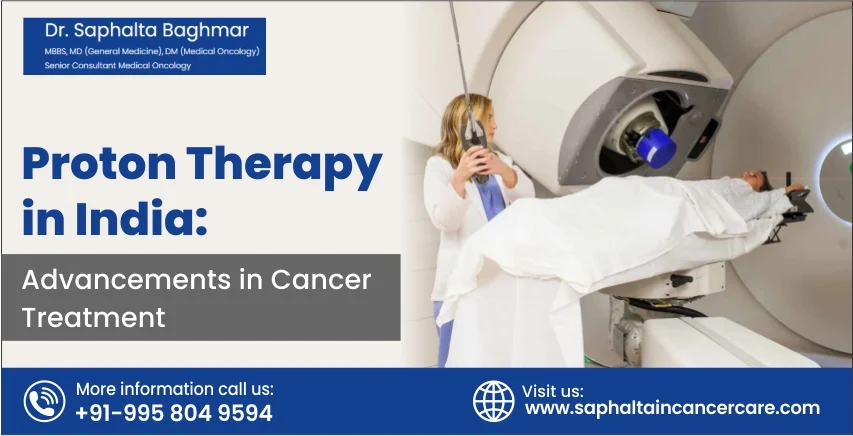
Proton therapy is the most reliable type of radiation therapy. It is safer than the other alternatives, has fewer side effects, and can be employed for several stages of cancer.
Chemotherapy
Chemotherapy, popularly known as chemo, is a type of cancer treatment in which drugs are used to kill cancer cells. The medications used here are of high power. So it is necessary that the patient is in good overall health to receive this treatment.
Targeted Therapy
Targeted therapy treats cancer by targeting the changes that occur in cancerous cells that cause them to grow, divide and spread. This method uses inhibitors of vital factors required for the growth and multiplication of cells. It includes CDK4 and CDK6 inhibitors, angiogenesis inhibitors, and monoclonal antibodies that act against the same type of antigen.
Immunotherapy
Immunotherapy treats cancer by enhancing your immune system to fight against cancerous cells. It makes use of medications that boost the activity of your immune system. This enables them to identify the cancerous cells and actively work towards eliminating them.
Radiation Therapy
Radiation therapy is among the most common approaches doctors opt for in treating cancer. It uses high doses of radiation that kills cancer cells and helps reduce tumors.
To get reliable and affordable latest cancer treatments in India, visit Dr. Saphalta Baghmar.
The New Reality: Cancer Treatment Is Becoming Modular
One major difference today is that cancer care is no longer one fixed, long hospital journey. It is increasingly broken into modules:
- Diagnostics and molecular testing
- Systemic therapy planning
- Radiation or surgical intervention
- Response assessment
- Maintenance and follow-up
Each block is planned separately, budgeted separately and timed separately. This modular design allows doctors to:
- Remove unnecessary hospital admission days
- Avoid repeating investigations
- Sequence therapies only when the response justifies it
The result is not only better medical precision but also lower cumulative cost.
The Quiet Role Of Multidisciplinary Tumour Boards
One of the strongest cost-saving tools is something patients never see.
Multidisciplinary tumour boards now run weekly in many large and mid-sized centres. Medical oncologists, radiation oncologists, surgeons, radiologists and pathologists review every complex case together. This reduces:
- Repeated scans
- Unnecessary biopsies
- Parallel referrals
- Overlapping treatments
The treatment pathway is decided once and clearly.
What is changing now is that similar models are reaching private and regional cancer centres as well.
Molecular Testing Is Becoming Selective, Not Excessive
There is a strong misconception that advanced cancer care always needs large genetic panels and costly molecular profiling.
In reality, experienced oncologists today are becoming more selective. Instead of running every available test, the focus is on:
- Disease-specific actionable markers
- Stage-specific decision points
- Therapy-changing information only
This avoids expensive reports that do not change treatment plans. For example:
- In certain breast cancers, limited targeted panels may be sufficient
- In lung cancer, only key driver mutations are prioritised first
- In colorectal cancer, selected markers guide immunotherapy decisions
This targeted testing approach cuts significant upfront costs without affecting outcomes.
Surgical Oncology Is Moving Towards Shorter Recovery Models
Enhanced Recovery After Surgery (ERAS) protocols are being integrated into cancer surgery. The focus is:
- Minimal invasive approaches where possible
- Early mobilisation
- Early feeding
- Faster drain and catheter removal
This results in shorter ICU usage, reduced hospital stay, and faster start of adjuvant therapies. Cancer surgery is no longer designed only for tumour removal. It is designed for faster transition into the next phase of treatment.
A Practical Shift: Treatment Decisions Now Include Financial Toxicity
One of the most meaningful changes in real clinical practice is that financial burden is now discussed openly during treatment planning.
Oncologists today increasingly consider:
- Monthly affordability
- Insurance limits
- Availability of patient assistance programs
- Long-term maintenance therapy costs
Instead of offering one rigid protocol, multiple medically acceptable options are discussed. This approach avoids situations where patients stop therapy midway due to exhaustion of funds.
Doctors such as Dr. Saphalta Baghmar regularly highlight that treatment completion has a much stronger impact on outcomes than using the most expensive available drug for only a few cycles.
Digital Follow-Up And Toxicity Monitoring Is Changing Outpatient Care
Patients on chemotherapy and immunotherapy traditionally required frequent hospital visits. Now, several centres use:
- Structured digital symptom reporting
- Nurse-led follow-up calls
- Remote lab review systems.
Early identification of side effects allows:
- Dose adjustments without admission
- Early supportive treatment
- Prevention of severe complications
This model reduces both medical risk and indirect expenses such as repeated travel and lost workdays.
A Changing Patient Profile Is Also Influencing Treatment Design
Today’s cancer patients are more informed, more digitally connected, and more involved in treatment discussions. This changes clinical conversations.
Patients increasingly ask:
- How long does this treatment need to continue
- What benefit is realistically expected
- What happens if therapy is stopped early
- What alternatives exist if finances become tight
This collaborative model results in more sustainable care planning.
Advanced Diagnostics Without Excess Intervention
Modern imaging and pathology have improved significantly. But smart centres avoid repeating tests unless clinically indicated. Integrated reporting platforms allow:
- Radiologists and oncologists to view previous scans easily
- Treatment response assessment using standardised criteria
- Avoidance of overlapping investigations
This approach reduces unnecessary financial and emotional burden.
Why International Patients Are Choosing Indian Oncology Centres
The growing interest from international patients is not only because of lower prices. It is mainly due to:
- Comparable protocols
- Experienced subspecialty oncologists
- Access to targeted therapy and immunotherapy
- English-based clinical communication
- Organised treatment scheduling
Shorter waiting times also allow faster treatment initiation.
The Future Direction
The future of cancer treatment in India will not be driven by only large machines or imported drugs.
It will be shaped by clinical data integration, treatment outcome audits, patient-reported outcome systems, decentralised trial networks, and local manufacturing of complex biologics.
The aim is not to copy Western healthcare models. The aim is to create a model that can realistically support long-term cancer care for a much larger population.
How Is The Cancer Treatment Plan Devised?
The first step after a cancer diagnosis is to choose the best oncologist available and consult with them about the right treatment path. After making a decision, your doctor and their team will plan and schedule your appointment for the treatment.
Treatment Planning
- While planning the cancer treatment, your doctor and their team will investigate the type and severity of the cancer.
- They will gather the necessary information, including your age, overall health status, and medications.
- They will also consider the location and size of the tumor; to do this, they would perform tests like CT scans, MRIs, and similar imaging techniques.
- As per the acquired information, they will decide on the treatment approaches, doses, and schedule.
How Much Do Latest Cancer Treatments Cost?
Cancer treatment may range between 3,000 to 15,00,000 lakhs per month. What types of treatment are required and how they should be treated is decided by the site of origin, stage, severity and type of cancer. To know more about this, you can consult Dr. Saphalta Baghmar.
She offers the latest, most reliable, and most effective services at an affordable and cost-effective price.
Get the Best Cancer Treatment by Dr. Saphalta
Under Dr. Saphalta Baghmar's supervision, you can receive the latest cancer treatment in India with customer-friendly service and at cost-effective prices. Dr Saphalta has insurmountable expertise in treating a wide variety of cancers. She excels in multiple cancer treatment methods and prescribes the best and most personalised treatment plan and combination of treatments based on the patient's overall health condition and other factors.
Cancer is the abnormal growth of cells that has the tendency to spread to the surrounding cells and tissues and even to other organs. To date, there are more than 200 types of cancers discovered. While some of them are very common, like lung cancer and breast cancer, there are even some rare forms of this disease, like hepatoblastoma and glioblastoma.
To choose the right treatment plan, Dr. Saphalta always takes into account the type and stage of cancer and how severe its symptoms are. Based on the precise investigative outcome, the options for treating cancer vary from immunotherapy to targeted therapy and other alternatives.
Dr Saphalta Baghmar is a popular and experienced oncologist well-versed in numerous cancer treatments. What makes her services even more customer-friendly is that she tailors the treatment plan separately for every patient. She reviews your case report and determines which treatment combination would be the most suitable for you.
She also provides extensive initial consultations to analyse your cancer's symptoms and the stage.
Targeted Immunotherapy Treatment By Dr. Saphalta Baghmar
Targeted immunotherapy is gaining increasing prominence among cancer patients. In this treatment method, the doctors look for genetic or protein anomalies in the patient’s tumour. These anomalies are used as templates to pair them with immunotherapeutic agents to target malignant cells.
Dr. Saphalta Baghmar has extensive experience with targeted immunotherapy. This method harnesses the power of your immune system to attack malignant cells.
Under Dr. Saphalta's care, targeted immunotherapies are showing great potential to cure numerous types of cancers.
Radiation Therapy advise by Dr. Saphalta- Things to Know
In one of Dr. Saphalta's cancer care services, she prescribes radiation therapy to kill malignant cells in some cases. It involves using high-energy X-Rays or other particles to eliminate the cancerous cells.
Radiofrequency Ablation Therapy for Pain Management in Cancer
As one of the latest cancer treatments, Radiofrequency Ablation (RFA) leverages heat to destroy cancerous cells. It is pretty standard for cancer patients to suffer from pain and agony. If you or your loved one has cancer, you can consult Dr. Saphalta for RFA therapy.
This method uses a needle to transmit the radio signals to the affected area that will, in turn, heat up the nerves. This procedure prevents pain signals from being sent to your brain’s receptors. Dr. Saphalta Baghmar is among the leading oncologists in Faridabad to offer RFA therapy for cancer patients.
Chemotherapy by Dr. Saphalta Baghmar
Dr. Saphalta specialises in providing chemotherapy to cancer patients who are stable enough to receive the hard drugs. Chemotherapy is a drug that leverages potent chemicals to kill rapidly developing cancer cells.
Dr. Saphalta Baghmar is an expert in treating cancer with various types of chemotherapy drugs. Here are some reasons to undergo chemotherapy under her supervision:
- To Treat Cancer
The primary objective of chemotherapy is to treat cancer in various parts of the body.
- Killing Hidden Cancer Cells
Dr Saphalta Baghmar may leverage chemotherapy to kill the hidden malignant cells.
- To Ease Symptoms
She is the best oncologist for palliative chemotherapy. Her services have helped many people relieve signs and symptoms of cancer.
Hormone Therapy by Dr. Saphalta Baghmar
Dr. Saphalta also provides hormone therapy to help you reign in the cancer symptoms. It is a type of cancer treatment that eliminates, blocks, and adds specific hormones to your body and is also known as endocrine therapy. Hormone therapy is one of the latest cancer treatment in India. Here are some ways in which hormone therapy helps in cancer treatment:
- Hormone therapy is suitable if you have recurrent cancer
- Hormone therapy has been found effective for patients with metastatic cancers.
- Hormone therapy is a potent treatment approach for people with breast cancer.
Dr. Saphalta Baghmar ensures that each patient has access to quality cancer treatment. She keeps abreast of the latest advancements in the medical field and strives to provide you with the best quality and the latest cancer treatment in India. Your well-being and satisfaction with her services are of utmost importance to her.
For more details regarding Dr. Saphalta Baghmar's cancer care services, contact us at drsaphaltabaghmar@gmail.com
Why Choose Dr. Saphalta Baghmar?
Dr. Saphalta Baghmar, one of the best oncologists in Delhi, is a reliable and highly preferred doctor for cancer treatment. With over 11 years of experience, she has gained extensive expertise in cancer care and therapy.
She works on cancer treatment with the help of advanced technology equipment. She is a member of the American Society of Clinical Oncologists (ASCO) and the European Society of Medical Oncologists (ESMO).
To get the best, most effective, affordable, and latest cancer treatments in India, you can visit Dr. Saphalta Baghmar